Write a One-Page Sign Brief for Your Small Business
A useful small-business sign brief answers four questions before the artwork starts: who needs to see the sign, what should they do, where will it be displayed, and what limits the project? Put those answers on one page, then use that page to compare products and quotes. This keeps a simple project from expanding into a collection of unrelated design requests.
Small businesses do not all operate from storefronts. The SBA Office of Advocacy’s February 2026 FAQ reports 36,207,130 small businesses, with 82.3% having no paid employees. These are published research figures based on earlier government datasets, not a current count of sign buyers. They are a useful reminder to plan for your actual operation rather than copying a standard retail sign package.
Choose the job before the message
Write one primary purpose: identify the business at a location, help visitors find an entrance, announce a specific event, or explain a service at a stationary display. Several purposes can belong in a coordinated project, but they should not compete equally on every sign.
Then describe the audience in practical terms. A person walking up to a booth has a different reading opportunity from someone identifying a parked service vehicle. Include whether the viewer can stop, whether staff are nearby and what other information is already available.
Replace “make it pop” with an observable task. “A visitor at the front door should recognize our business name and see which entrance to use” gives the designer something to solve. It does not promise a sales result that the project has not measured.
Bring location evidence
Take straight-on and wider photographs showing the surrounding area. Measure the usable space, note obstructions and identify the surface or supporting structure. Record whether the location is indoors, exposed outdoors or subject to conditions that need product-specific confirmation.
Include the person who can approve placement. A design fitting a wall does not establish permission to install it there. Building, property, event and local requirements should be resolved separately from the artwork.
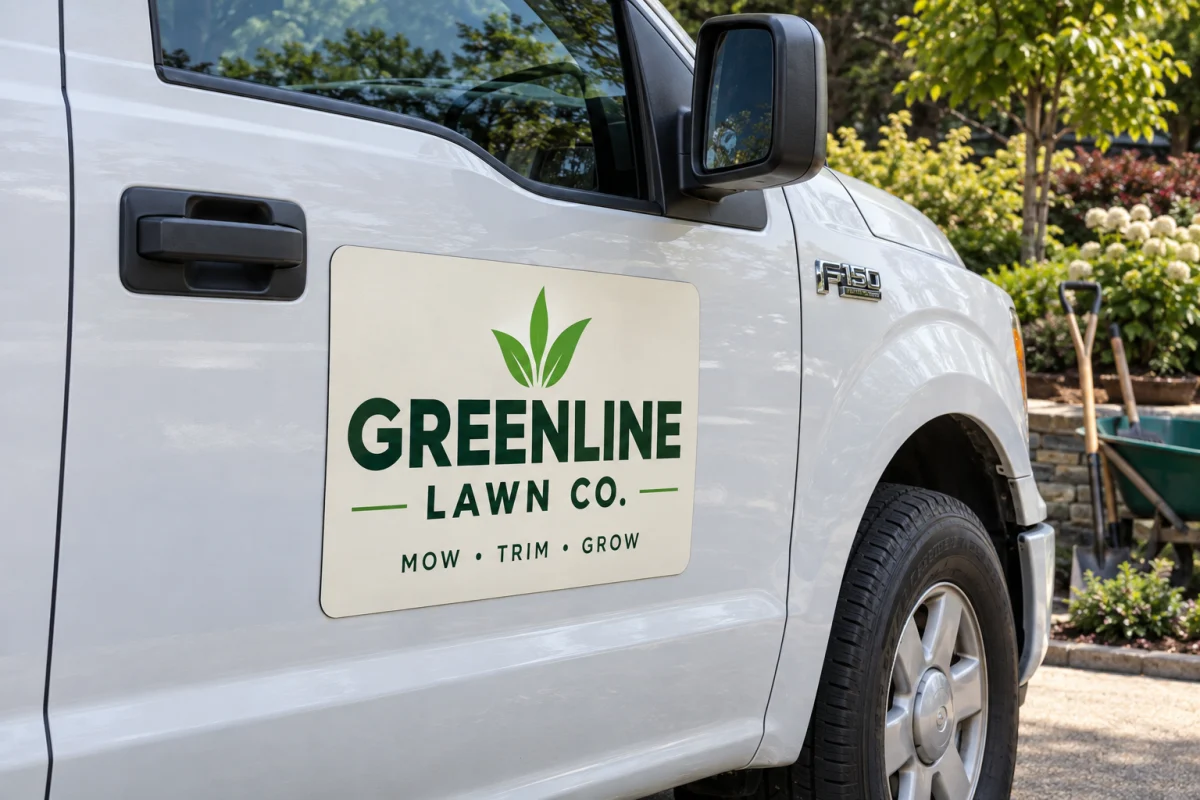
For a service vehicle, check the panel itself before choosing vehicle magnets. The product instructions call for a magnet-receptive surface with full flat contact. A door’s available dimensions do not prove that its material or shape will work.
Write the brief in plain fields
- Purpose: the one thing this sign must help someone understand or do.
- Audience and viewing situation: who sees it and where they are.
- Location: photographs, measured space, surface and permission contact.
- Approved message: business name, necessary contact or action, and any dates.
- Artwork: available logo files, photographs, brand references and who approves them.
- Product questions: support, finishing, portability, environmental conditions and replacement needs.
- Order scope: quantities, required arrival date, destination and budget boundaries.
If the business moves between indoor events, a banner stand is worth considering within its intended setting. If the project is a fixed indoor identity display, printed acrylic raises different mounting and artwork questions. The brief helps identify those differences before comparing totals.
Separate the budget from the expected return
Use a budget worksheet with explicit allowances rather than assuming the graphic price covers everything. A hypothetical $600 project could reserve $80 for artwork, $260 for printed pieces, $90 for hardware and $70 for shipping or handling, leaving $100 unallocated.
The calculation is $600 − ($80 + $260 + $90 + $70) = $100. These are invented planning amounts, not current prices, tax-inclusive quotes or recommended spending levels. Actual installation, tax, revision and delivery costs need their own confirmation.
A budget tells you what can be spent. It does not tell you how much business the sign will generate. If measurement matters, add a separate plan for inquiries, campaign links or another appropriate outcome rather than inserting an unsupported ROI promise into the brief.
Agree on the decision and keep the record
Name one final approver and collect comments into one revision list. Ask that person to compare the proposed design with the original purpose, not only personal color preferences. Confirm product, quantity, finishing and delivery expectations before the order is released.
Keep the approved brief, artwork and order details together for future changes. Once the message and location are clear, Sign Designer can help turn the brief into editable artwork. A short, complete record makes the next conversation more specific and the next revision easier to explain.